Guide
Broiler farming in Zimbabwe
From day-old chick to sale in about six weeks: preparing the house, feeding, vaccination, keeping disease out and finding buyers.
- Broiler meat, 2025
- 243,276 t
- Grown by small-scale
- 80%
- Feed share of costs
- About 60%
- Cycle
- About 6 weeks
Most of Zimbabwe's broilers are now grown by small-scale farmers. Feed and disease decide whether a batch makes money.
1. Why broilers, and who you are up against
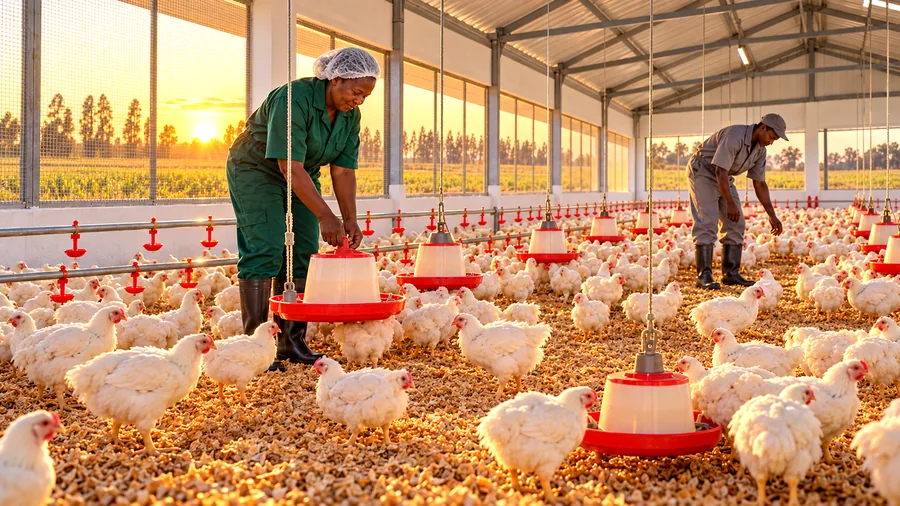
Broilers are the quickest livestock money in Zimbabwe: a batch goes from day-old chick to market in about six weeks. That speed is why so many people start with them, and why the market is crowded.
Zimbabwe produced 243,276 tonnes of broiler meat in 2025, up 18.2% on 2024. Small-scale producers grew 80% of it.1 The Zimbabwe Poultry Association puts all chicken meat at 277,472 tonnes in 2025, or about 17.5 kg per person, and says chick production has grown faster than abattoir capacity, leaving room for small abattoirs outside the big cities.2 The government's 2026–2030 agriculture strategy aims for 362,000 tonnes of broiler meat by 2030/31.3
The same strategy names the problems: feed at about 60% of production costs, disease including avian influenza, cheap illegal imports, and shortages of finance and infrastructure.2 A broiler business that works plans for all of them.
2. Before the chicks arrive
- Find your buyers first. Birds keep eating after they reach market weight, so every extra day cuts the margin. Line up buyers (neighbours, butcheries, schools, vendors, restaurants) before you order chicks.
- Order from a known hatchery and ask in writing which vaccines the chicks have already had. Many Zimbabwean hatcheries now vaccinate against Gumboro in the egg, which changes what you need to do on the farm.4
- Clean and rest the house. Clean and disinfect the fowl run and equipment, and put down 7–10 cm of dry litter such as wood shavings or chopped dry grass.5
- Heat it the day before. Bring the brooding area to about 32–33 °C at chick level before the chicks come.5
3. The six weeks
Weeks 1–2: brooding
Warmth, clean water and starter crumbs. Check the chicks soon after placing: huddled chicks are cold, panting chicks are too hot. The first 14 days set the performance of the whole batch.4
Feed: broiler starterWeeks 3–4: growing
Lower the heat as the birds feather up, give them more floor space, more feeders and more drinkers, and keep the litter dry.6
Feed: broiler growerWeeks 5–6: finishing
Finisher feed to market weight. Weigh a sample of birds each week so you know when they are ready, and stop any in-feed medicine early enough to meet the withdrawal period on its label.
Feed: broiler finisher
Vaccination. Zimbabwe is treated as a high-challenge area for Newcastle disease. Profeeds' guide suggests a Newcastle vaccine at about day 11 and another at day 18 in such areas, and says the Gumboro vaccine may not be needed if the hatchery has already given it. Check with your chick supplier and a vet before you settle on a programme.4
4. Keeping disease out
The Commercial Farmers' Union of Zimbabwe lists these as the habits of successful broiler farmers:6
- A foot bath at every door, and a fence with a lockable gate to keep out dogs, cats, road runners, ducks, guinea fowl and visitors.
- One age of bird per house, at least 10 m between broiler runs and 20 m between broilers and layers.
- No other livestock mixed with the chickens, and clothes kept just for the fowl run.
- Dead birds removed quickly and, if several die, sent to a vet for a post-mortem.
Report sudden, heavy deaths to your nearest veterinary office straight away. Avian influenza is a notifiable disease and the Poultry Association has urged farmers to step up vaccination, surveillance and biosecurity.7
5. Selling the birds
- Live or dressed. Live birds are simplest for neighbours and vendors. Dressed birds reach shops and institutions, but ask your local council and the Department of Veterinary Services what slaughter and meat-inspection rules apply before you sell to them.
- Price by weight. Agree whether the price is per bird or per kg, and weigh in front of the buyer.
- Keep records of chicks placed, feed used, deaths and birds sold. Feed per kilogram of bird sold is the number that tells you whether the batch made money.
- Advertise early. List the batch a week or two before it is ready, with the number of birds, the ready date, the price and the area.
You can list broilers, chicks, layers and eggs free on the poultry board, and buyers can see everything for sale in their area on the marketplace. Buyers: ask for the vaccination record and where the chicks were hatched, and see the birds before you pay.
Checklist
- Buyers lined up before the chicks are ordered
- Chicks from a known hatchery, vaccines already given confirmed in writing
- House cleaned, disinfected, littered and pre-heated
- Starter, grower and finisher feed budgeted for the whole batch
- Vaccination programme agreed with the supplier or a vet
- Foot bath, fence and one age of bird per house
- Records of feed, deaths and sales for every batch
This guide is not veterinary advice. Disease rules and vaccination needs vary by area. Talk to your chick supplier, a vet or your local agricultural business adviser (AGRITEX) before you start.
Sources
- ZimStat — Environmental Resources Statistics 2025 report, Table 12: broiler meat production 2020–2025
- The Herald — Zim's poultry output gross value surges past US$1.2bn (2026)
- Ministry of Lands, Agriculture — Agriculture Food Systems and Rural Transformation Strategy 2 (2026–2030), via FAOLEX
- Profeeds — Poultry management guide
- Hurudza Agricentre — Broiler management practices
- Commercial Farmers' Union of Zimbabwe — 7 tips of successful broiler production
- The Diplomat — Zimbabwe Poultry Expo 2026 opens with calls for biosecurity, investment and innovation